From ‘Me’ to ‘We’: The Effect of a Gamified Community Leaderboard on User Content Creation
While the literature on user-generated content (UGC) has focused on incentive designs that motivate content creation through individual achievement and recognition, community-centric designs that leverage collective motivation are understudied. To address this gap, this study investigates how a gamified community leaderboard affects user content creation. We leverage a natural experiment from a leading social media platform in China that introduced a leaderboard for its superstar communities, allowing a randomly selected subset of users to earn points through content creation and contribute them to their community’s ranking. Using a difference-in-differences research design, we find that the leaderboard significantly increased the volume of both original posts and comments. This quantity increase was accompanied by a striking asymmetric effect on quality: while comment quality declined significantly, the quality of original posts remained unchanged. This suggests that users strategically preserve quality for highly visible content that represents their community while compromising on less prominent contributions. A causal forest analysis further reveals that the treatment effects are stronger for users with a stronger social identity and exhibit a U-shaped relationship with community size. Our findings provide important implications for designing effective community engagement strategies on UGC platforms.
The Question: Competing for “Me” or for “We”?
Platforms that rely on user-generated content (UGC) need users to keep creating. Most incentive designs reward individuals: badges, points, personal leaderboards.
But many users also care about the communities they belong to. What happens when users compete not for themselves but for their community? Does collective motivation drive more content, and does it come at a cost to quality?
The Setting: A Leaderboard for Fan Communities
We study a leading social media platform in China with a microblogging service. Its superstar communities are dedicated spaces where fans of a celebrity gather and interact.
The platform introduced a community leaderboard. Users earn points by logging in, posting, and commenting, then contribute those points to their community. A public leaderboard ranks the communities in real time.
Crucially, the platform first rolled the feature out to a randomly selected subset of users for four weeks before launching it to everyone. Users outside that subset could not see the leaderboard. This gives us a natural experiment. We compare treated and control users before and after the launch using a difference-in-differences design.
What We Find
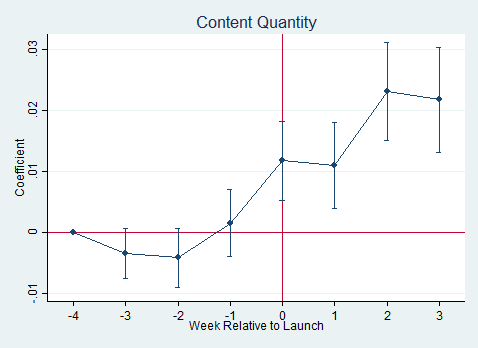
1. More content, especially comments
The leaderboard significantly increased the volume of both original posts and comments, with most of the increase coming from comments. A back-of-the-envelope calculation suggests roughly 590,000 additional posts and comments per day across superstar communities.
2. A striking asymmetry in quality
More content did not mean better content, but only for one type of content:
- Comments got worse: shorter, fewer likes, and more duplicates.
- Original posts held up: their quality did not change.
Users appear to strategically preserve quality for highly visible content that represents their community, while cutting corners on less prominent contributions.
The competition between communities also did not make the language more aggressive.
3. Who responds most?
A causal forest analysis shows that the effects are stronger for users with a stronger social identity with their community. The effects also have a U-shaped relationship with community size: they are stronger in small and large communities than in mid-sized ones.
Why It Matters
A community leaderboard can be a double-edged sword: it boosts participation, but it can dilute quality where contributions are least visible. Platforms can keep the benefits while limiting the costs:
- Build gamification around high-visibility original content, whose quality held up.
- Add guardrails for comments, such as minimum lengths, penalties for duplicates, or awarding points only for non-duplicate comments or comments that reach a threshold number of likes.
- Tailor the design to user segments and community sizes.