The Effects of Collective Certification Programs on E-commerce Sellers
Platform certifications typically recognize individual sellers or products, yet the effects of “collective, community-level” certification remain unexplored. We investigate such collective certification in the context of Alibaba’s Taobao Town Certification (TTC), which recognizes all sellers in a rural town once the town meets e-commerce eligibility criteria. We develop a framework in which TTC can diffuse a town’s reputation through external information channels and facilitate collective coordination among sellers within local clusters. Using seller panel data from four Chinese provinces and a causal forest difference-in-differences design, we find that TTC increases quarterly sales by 13.8% and orders by 8.8% on average. TTC produces no statistically detectable expansion in product-category breadth on average, while sellers’ sales shift toward the town’s leading category. The causal forest also predicts conditional treatment effects at the seller level, allowing us to investigate the distribution of gains and how they vary with seller and regional characteristics. The distribution is uneven: 34.3% of treated sellers have nonpositive predicted sales effects. Sales and order effects are larger in less-developed counties, among enterprise sellers, and in more collectivist regions. Our results indicate that collective certification can support rural e-commerce and may help narrow regional disparities, although its benefits remain unevenly distributed within certified towns.
The Question: What If a Platform Certifies a Whole Town?
Online platforms certify sellers all the time: eBay’s Top Rated Seller, Amazon’s Choice badge, and so on. These labels recognize individual sellers or products.
Alibaba took a different route. Since 2014, its Taobao Town Certification (TTC) has recognized entire rural towns once they meet e-commerce eligibility criteria. Every seller in a certified town is recognized collectively. The label is purely honorary: it brings no preferential treatment on the platform and no government subsidy, and during our study period it was not even shown on Taobao’s transaction pages.
So can a collective label make a difference to individual sellers? And if it does, who actually benefits?
Two Ways a Collective Label Can Help
We develop a framework with two channels:
- Reputation diffusion (demand side). Certification can spread a town’s reputation to buyers through external information channels, so that sellers benefit from being associated with a recognized e-commerce town.
- Collective coordination (supply side). Certification can give sellers a shared identity to rally around and help them coordinate within local clusters and draw on shared cluster resources.
Data and Approach
We use a quarterly seller-level panel from Alibaba covering four Chinese provinces (Zhejiang, Guangdong, Henan, and Sichuan) from 2015 to 2019. We compare sellers in towns certified in 2016, 2017, or 2018 with sellers in towns that were never certified. The sample covers more than 133,000 sellers in certified towns.
To estimate the effects, we embed a causal forest in a difference-in-differences design. Beyond the average effect, the causal forest predicts how much each seller gains from certification. That lets us look at the whole distribution of gains and at which sellers and regions gain the most.
What We Find
1. Certification boosts sales and orders
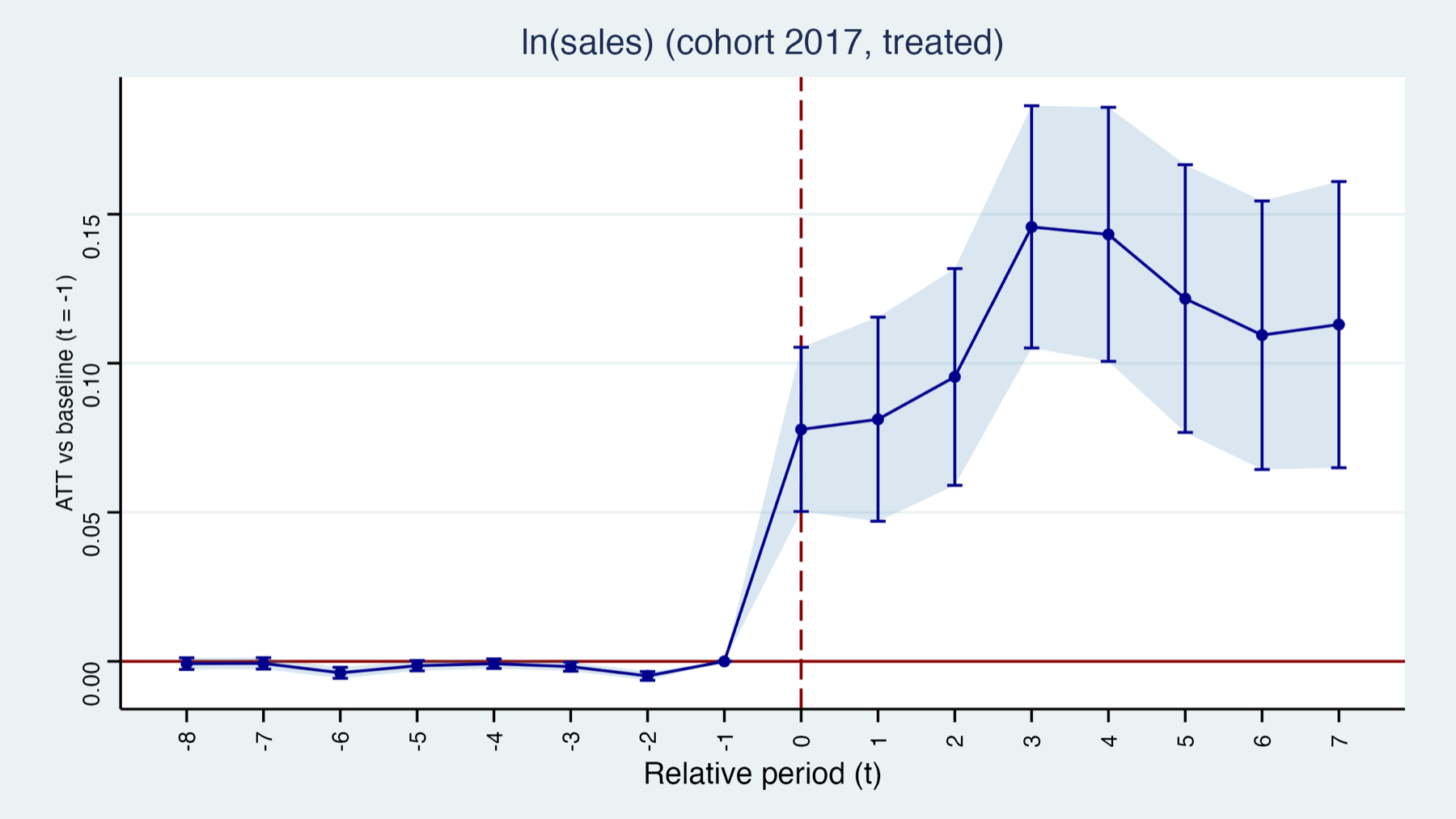
On average, TTC increases sellers’ quarterly sales by 13.8% and orders by 8.8%. Sellers in certified and uncertified towns follow parallel paths before certification, and the gap opens up right after it:
2. Sellers lean into the town’s signature product
Certification does not make sellers expand into more product categories. Instead, their sales shift toward the town’s leading category: that category’s share of a seller’s sales rises by 0.9 percentage points.
3. The gains are uneven
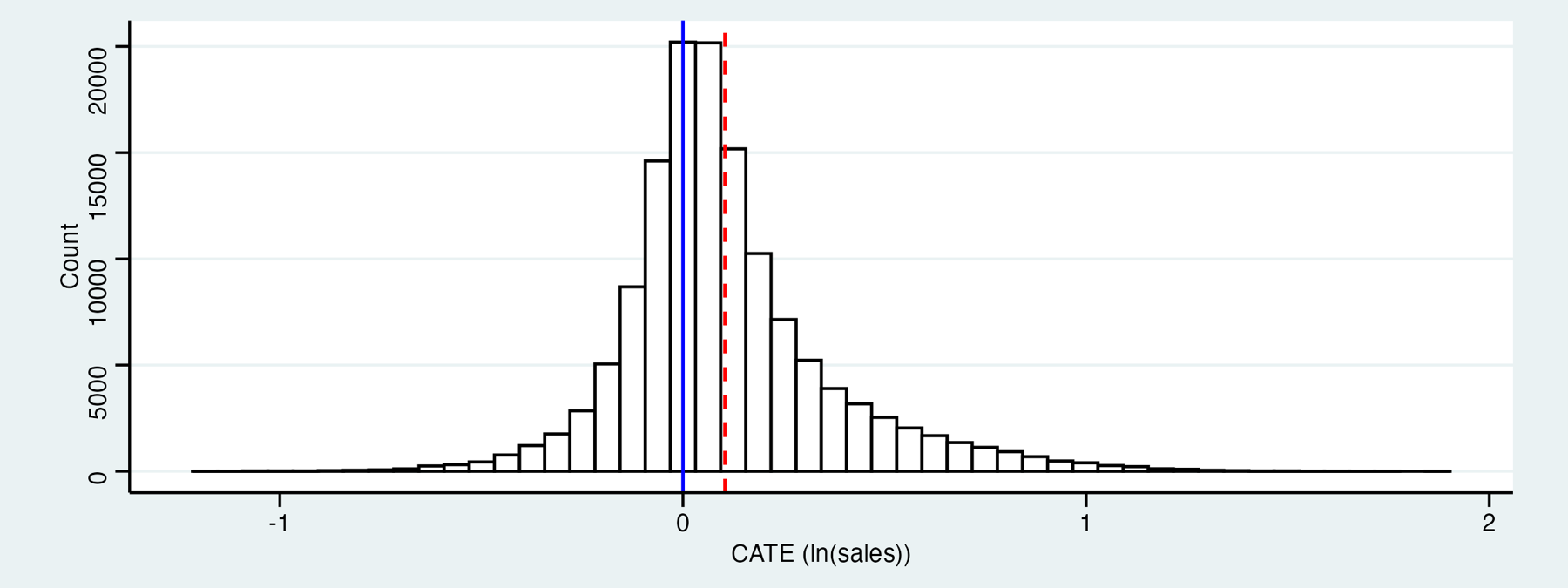
The average effect masks a lot of variation. 34.3% of sellers in certified towns have a predicted sales effect of zero or below.
4. Who gains the most?
Sales and order gains are larger:
- in less-developed counties,
- among enterprise sellers, and
- in more collectivist regions.
These patterns line up with the two channels: larger gains in less-developed counties are consistent with reputation diffusion, and larger gains in more collectivist regions are consistent with collective coordination.
Why It Matters
Collective certification can support rural e-commerce and may help narrow regional disparities. But the benefits are not shared equally within certified towns.
For platforms and policymakers, this means judging such programs by how the gains are distributed, not just by the average effect. Complementary support for individual sellers, such as open access to shared procurement and logistics resources and help joining local supplier networks, can spread the gains more widely. Showing certification directly on the platform, for example through badges or search features, could amplify the effect further.