Does Consumer Privacy Protection Always Hurt Companies? Evidence from Apple’s App Tracking Transparency Policy
Brands commonly collect personal data through their mobile apps to enhance targeting capabilities. However, privacy regulations increasingly restrict such data collection and may lead to decreased targeting efficiency. This paper examines the impact of privacy regulations on consumer purchasing behavior, using Apple’s App Tracking Transparency (ATT) policy as an exogenous shock. Leveraging data from a leading coffee chain in China, we regard iPhone users as the treatment group and Android users as the control group, and estimate a causal forest model within a difference-in-differences framework. Our findings reveal that, following the implementation of ATT, iPhone users exhibited greater responsiveness to coupons and increased their spending compared to Android users. The effects are particularly pronounced among female customers and privacy-sensitive individuals, suggesting that enhanced privacy controls foster consumer trust and engagement. However, the positive effects were weaker for newly acquired customers and those who previously used fewer coupons, suggesting the presence of an efficiency-decreasing effect. Our results indicate that privacy regulations granting users greater control over their personal data can benefit both consumers and businesses, even amidst potential declines in targeting efficiency.
The Question: Is Privacy Protection Bad for Business?
The conventional wisdom is that privacy rules hurt firms. If brands can collect less personal data, their targeting gets less precise, and their marketing works less well. We call this the efficiency-decreasing effect.
But there is another possibility. Giving consumers real control over their data might make them trust the brand more and engage with it more. We call this the trust-enhancing effect.
Which effect wins? Apple’s App Tracking Transparency (ATT) policy gives us a natural experiment. Introduced with iOS 14.5 in April 2021, ATT requires apps to ask iPhone users for permission before tracking them. Android users were not affected.
Data and Approach
We work with data from a leading coffee chain in China whose customers order through its mobile app. Our sample covers about 230,000 customers over the six months before and after ATT (October 2020 to October 2021).
We treat iPhone users as the treatment group and Android users as the control group, and estimate a causal forest within a difference-in-differences framework. Because the firm does not observe which iPhone users opted out of tracking, we estimate the effect of having the choice.
What We Find
1. iPhone users used more coupons and spent more after ATT
Relative to Android users, iPhone users became more responsive to coupons after ATT, using about 9% more coupons per month (relative to the pre-ATT average), and they spent more, placed more orders, and bought more items.
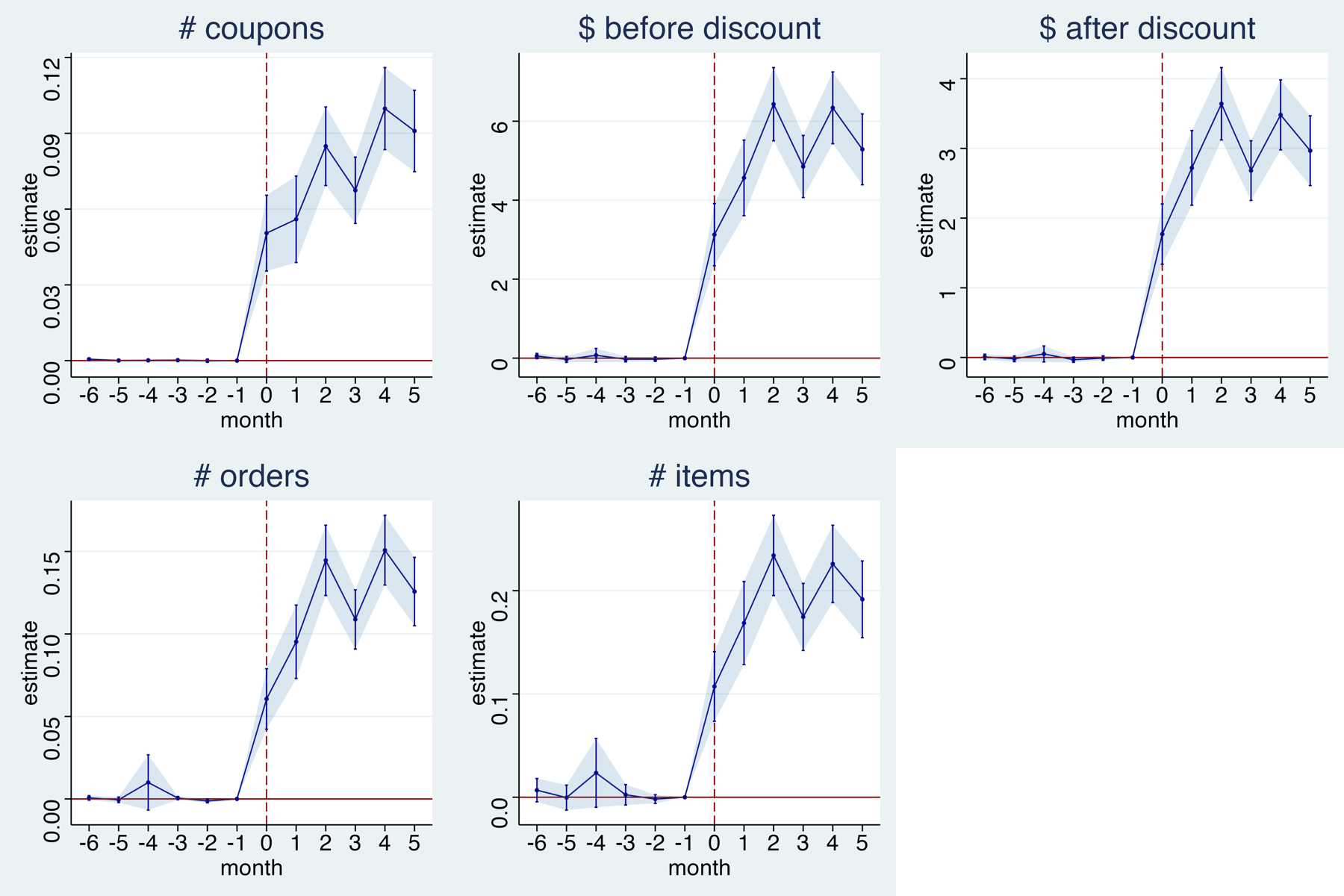
The increase does not appear to come from changes in the firm’s own coupon strategy. Orders placed without coupons also rose, and coupons sent to inactive customers did not change.
2. Evidence of trust: larger effects for privacy-conscious customers
The effects are particularly strong among female customers and privacy-sensitive customers (those who had granted the app fewer permissions). This pattern suggests that giving users control over their data fosters trust and engagement.
3. Evidence of lost efficiency: smaller effects for newer customers
The positive effects are weaker for newly acquired customers and customers with less history with the brand, about whom the firm has less first-party data. This is consistent with an efficiency-decreasing effect: targeting these customers became harder once tracking was restricted.
For most customers, the trust-enhancing effect outweighs the efficiency loss.
Why It Matters
Privacy protection is not necessarily a zero-sum game between consumers and firms. Regulations that give users greater control over their personal data can benefit both consumers and businesses, even if targeting becomes less efficient.
For brands, the lesson is that respecting privacy and being transparent about data practices can be a source of trust, and of revenue, rather than only a compliance cost.